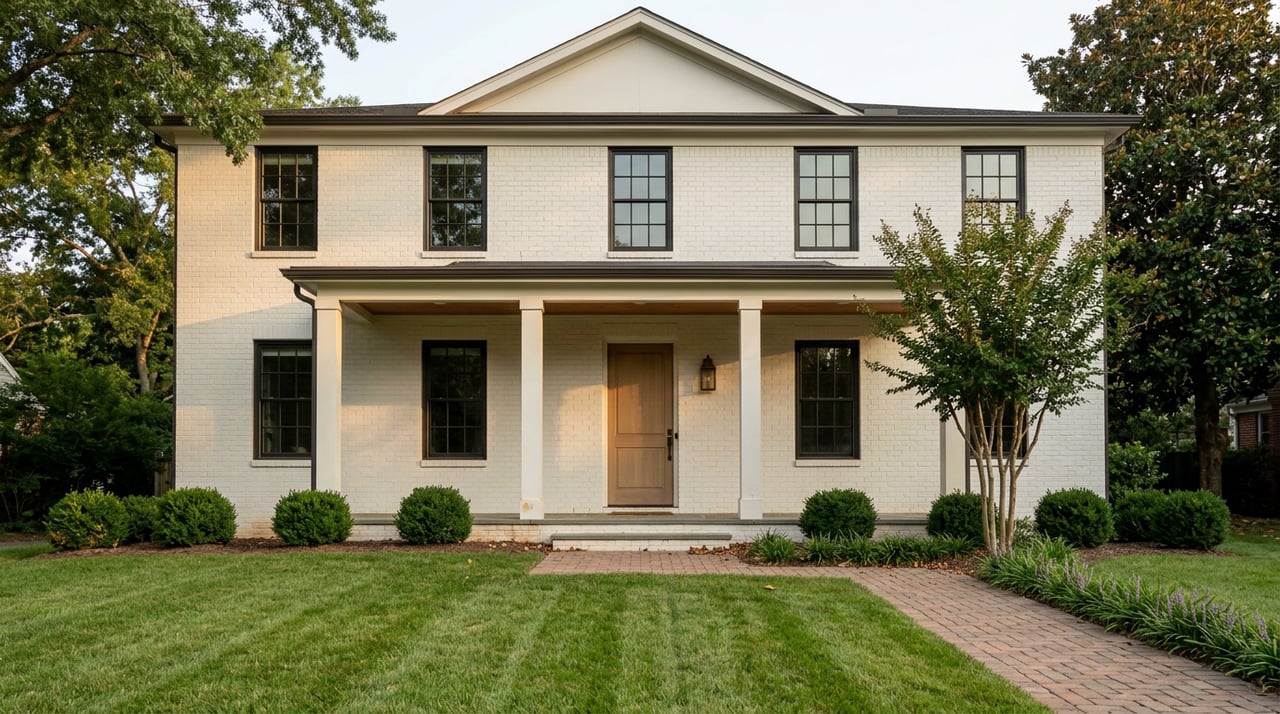
Two homes in Spring Hill can sit less than a mile apart on nearly identical lots, in the same style of subdivision, built by the same production builder, and still close $200,000 apart. The finishes aren't different. The floor plans might be the same plan number. What's different is which side of the Williamson-Maury county line the lot happens to fall on.
As of mid-2026, homes on the Williamson County side of Spring Hill were trading closer to $715,000, while comparable homes across the line in Maury County were running closer to $490,000. Same town. Same road, in some cases. Different school district, different price. A buyer scanning listings by city name alone has no way to see that split, because the portal search box doesn't know where the county line runs through a subdivision.
That single fact turns out to be a small version of something bigger happening across the entire county. The town name on a listing tells you far less than which side of an invisible line a house sits on, whether that line is a county border, a school zone boundary, or the edge of where new construction stopped and an older subdivision started.
Same Town, Two Different Markets
Spring Hill isn't the only place where this matters, it's just the clearest example because the county line runs directly through it. Communities like Canterbury include sections zoned to Williamson County Schools sitting a few streets away from sections zoned to Maury County Public Schools, with the price difference following the school assignment rather than the finish level of the home.
For a buyer comparing towns, the practical takeaway isn't complicated, but it is easy to skip. Before comparing a $550,000 Spring Hill listing to an $850,000 Thompson's Station listing and concluding Spring Hill is the value play, confirm which county and which school zone that specific address falls in. A blended town-wide median is an average of two different markets, and averaging them together erases the number that actually matters to a family choosing where to live.
What Each Submarket Actually Looks Like Right Now
Pulled together, the county's five main submarkets tell a more interesting story than any single median price suggests.
| Town | Median Sale Price | Recent Trend |
|---|---|---|
| Franklin | $864K (three months ending June 2026) | Up 5.3% year over year, homes moving in around 48 days |
| Brentwood | Roughly $1.3M to $1.6M through 2026 | Deep luxury tier, priced for size and finish more than speed |
| Spring Hill, Williamson County side | About $715K (mid-2026) | Outpacing Franklin's appreciation rate, moving in roughly 47 to 60 days |
| Nolensville | Around $950K (trailing 24 months through July 2026) | Structurally undersupplied, sustained buyer pressure |
| Thompson's Station | About $890K (mid-2026) | Premium held on newer, larger-lot construction, moving in around 61 days |
Read individually, these numbers look like separate stories about separate towns. Read together, they show something else. Brentwood, the most expensive submarket, is also the one where sellers can afford to wait for the right buyer, which reflects a deep luxury tier where presentation and patience both matter more than urgency. Spring Hill, the least expensive submarket on its Williamson County side, is moving nearly as fast as Franklin. That's not a coincidence. It's demand looking for the next available ring.
Why the Cheaper Suburbs Are Catching Up
Franklin and Brentwood have functioned as Williamson County's front door for years, and that front door is getting more expensive to walk through. As prices in the established core climb, some buyers who would have settled there a few years ago are instead looking one town over, where the school district is identical but the entry price is lower.
One 2026 market forecast projected Spring Hill's appreciation at roughly 5.1 percent for the year against Franklin's 4.2 percent, a gap that lines up with where buyer demand is actually landing. Spring Hill's Williamson County side also benefits from a steady, non-market-driven source of demand: the General Motors Spring Hill Assembly plant and its Ultium Cells battery operation employ thousands of hourly workers who need housing within a reasonable commute, which keeps continuous buyer pressure on homes in the mid-$300,000s to $500,000s regardless of what mortgage rates are doing elsewhere in the county.
Nolensville tells a related but distinct story. Rather than a large employer anchoring demand, Nolensville is working through a straightforward supply problem, with new-construction communities like Annecy, Telluride Estates, and Scales Farmstead absorbing demand faster than new lots are coming online. Thompson's Station sits at the opposite end of that spectrum, commanding a genuine premium for larger lots and newer construction in places like Bridgemore Village and Tollgate Village, where sellers in mid-2026 were still receiving close to 99.5 to 99.6 percent of asking price, leaving buyers very little room to negotiate on a well-presented home.
A town's median price is really two or three markets averaged together, and the seam between them is usually where the real number lives.
The School Zone Squeeze Is Tightening Specific Streets, Not Whole Cities
The Williamson County Schools premium isn't a new phenomenon, but it has been widening. Families who a decade ago might have settled for East Nashville or Sylvan Park and accepted whatever school assignment came with it are now bypassing those neighborhoods entirely and moving straight into Williamson County, specifically for the district.
That shift doesn't spread evenly across every zip code. It concentrates in specific attendance zones. The tightest of these, where days on market consistently run below the broader county average, include the Ravenwood, Brentwood High, Independence, and Nolensville High zones. Two homes in the same city, one zoned to one of these attendance areas and one zoned just outside it, can move at meaningfully different speeds even when their list prices are close.
For a family narrowing down a search, this means the useful comparison isn't Franklin versus Brentwood as cities. It's the specific school your child would attend versus the specific school a comparable home two streets over feeds into. Verifying that assignment before falling in love with a listing photo is a small step that changes the entire calculation.
The Inventory You Don't See on a Portal
There's one more piece of this that rarely shows up in a portal search. A meaningful share of Williamson County's transactions above the $1 million mark, and a fair number in well-established neighborhoods below that threshold, close off-market or through Coming Soon and Private Exclusive listings rather than a standard public listing. A buyer relying solely on public search sites is, by definition, only seeing part of the available inventory in the price range where competition is highest.
This is one advantage of working with a Compass-affiliated team on the ground in Williamson County. Access to Private Exclusive and Coming Soon inventory means seeing homes before they hit a public search, and Compass Concierge allows sellers to fund pre-listing preparation with no upfront cost, repaid at closing, which matters in submarkets like Brentwood where presentation and finish level directly affect how long a home sits.
FAQ
Does a lower median price always mean a better deal? Not on its own. Brentwood's higher median is driven largely by a bigger share of large, luxury-tier homes rather than a dramatically higher price for comparable square footage. For a true apples-to-apples read, compare price per square foot for homes similar in size and condition rather than relying on the town-wide median.
How do I find out which side of a county line a specific address sits on? Ask directly before writing an offer, especially in border communities like Spring Hill. School zone and taxing jurisdiction can change from one side of a subdivision to the other, and that detail affects both your monthly costs and your resale pool later.
Are the secondary suburbs a riskier long-term bet than Franklin or Brentwood? Faster appreciation in Spring Hill, Nolensville, and Thompson's Station reflects real demand pressure, not speculation. Franklin and Brentwood carry an established prestige premium that secondary suburbs haven't built yet, so the tradeoff is between paying for that established position now or buying into a market still catching up to it.
Comparing towns across Williamson County means comparing more than a median price on a search page. It means knowing which side of a school zone, a county line, or a construction era a specific address falls on, because that's usually what's actually setting the number. If you're weighing Franklin against Spring Hill, or trying to figure out what a Nolensville listing really compares to, The Reed Collective can walk through the specific streets and zones that matter for your search. Reach out for a conversation about your goals, or request a free home valuation to see where your own numbers stand today.